Our Location

4901 NE 2nd St, Renton, WA 98059

Call Us

(425) 273-4313

Lynnwood Deck Builders for Moisture-Resistant, Code-Ready Outdoor Structures
Honeycomb Deck Builders designs and builds custom decks, covered decks, architectural pergolas, and structural deck resurfacing projects for homeowners in Lynnwood, Edmonds, Mountlake Terrace, Mukilteo, and Mill Creek. Lynnwood decks face a hard mix of Puget Sound rain, high relative humidity, shaded yards, mold pressure, and winter freeze-thaw cycles, and a deck that ignores moisture movement can start failing below the boards before the surface looks worn.

How Puget Sound Moisture Damages Lynnwood Decks

Western Washington is rough on deck materials because the moisture cycle never really leaves the structure alone. Deck boards absorb water during wet months. Shaded framing stays damp after rain clears. Mold spores settle into organic material. Winter freeze-thaw movement stresses fasteners, end grain, and board edges, then summer heat dries the surface quickly and forces the boards to contract.

With traditional softwoods like Western Red Cedar or pressure-treated pine, that repeated movement plays out in a fairly predictable sequence: boards swell across the grain during wet winters, fasteners loosen as the boards move, dry summer weather contracts them again, and checking, cupping, splitting, and surface graying show up. Joists and stair stringers hold moisture at their connection points, and rot develops wherever water sits between the decking and the framing underneath.

Cedar can still be a good material, but it demands maintenance discipline. In damp, shaded Lynnwood yards, wood isn’t a passive surface. It has to be cleaned, sealed, inspected, and protected from trapped water.

Why Composite and PVC Board Spacing Matters

Composite and cellular PVC boards expand and contract with temperature, which is why end-to-end spacing isn’t optional. If an installer leaves tight butt joints on a long composite run, the boards can expand into each other during hot weather, and that pressure causes buckling, fastener shear, edge distortion, or visible waves in the surface.

A proper Lynnwood deck installation accounts for product-specific expansion gaps, correct hidden clip spacing, board-end movement, joist layout, ventilation below the deck, heat exposure on south-facing surfaces, and drainage under shaded tree cover. A clean composite deck depends on getting those gaps right, not just picking a good board.

Cedar vs. Composite vs. PVC: Total Cost Over Time

Western Washington is rough on deck materials because the moisture cycle never really leaves the structure alone. Deck boards absorb water during wet months. Shaded framing stays damp after rain clears. Mold spores settle into organic material. Winter freeze-thaw movement stresses fasteners, end grain, and board edges, then summer heat dries the surface quickly and forces the boards to contract.

With traditional softwoods like Western Red Cedar or pressure-treated pine, that repeated movement plays out in a fairly predictable sequence: boards swell across the grain during wet winters, fasteners loosen as the boards move, dry summer weather contracts them again, and checking, cupping, splitting, and surface graying show up. Joists and stair stringers hold moisture at their connection points, and rot develops wherever water sits between the decking and the framing underneath.

Cedar can still be a good material, but it demands maintenance discipline. In damp, shaded Lynnwood yards, wood isn’t a passive surface. It has to be cleaned, sealed, inspected, and protected from trapped water.

Western Red Cedar

gives Lynnwood homeowners a classic Northwest finish and natural decay resistance, but it's still a softwood that dents, moves, checks, and needs routine sealing. It fits covered deck accents, pergolas, and natural wood designs for homeowners who accept ongoing maintenance.

Capped composite boards

(Trex and TimberTech-style) use a recycled wood-fiber and plastic core wrapped in a protective shell that resists fading, staining, and moisture damage better than exposed timber. It fits deck resurfacing, family entertaining spaces, and mid-to-upper budget projects, though the frame still matters. Soft joists, wrong spacing, or poor drainage will undercut composite boards regardless of the product.

Cellular PVC

(TimberTech AZEK-style) has no organic wood fiber, which makes it a strong fit for Lynnwood yards with shade, tree cover, high humidity, and slow drying. It fits damp yards, fully shaded decks, and projects planned for 30 to 50 years of use, but it needs precise expansion spacing and stiff framing to perform.

Deck Resurfacing: A Smarter Path When the Frame Is Sound
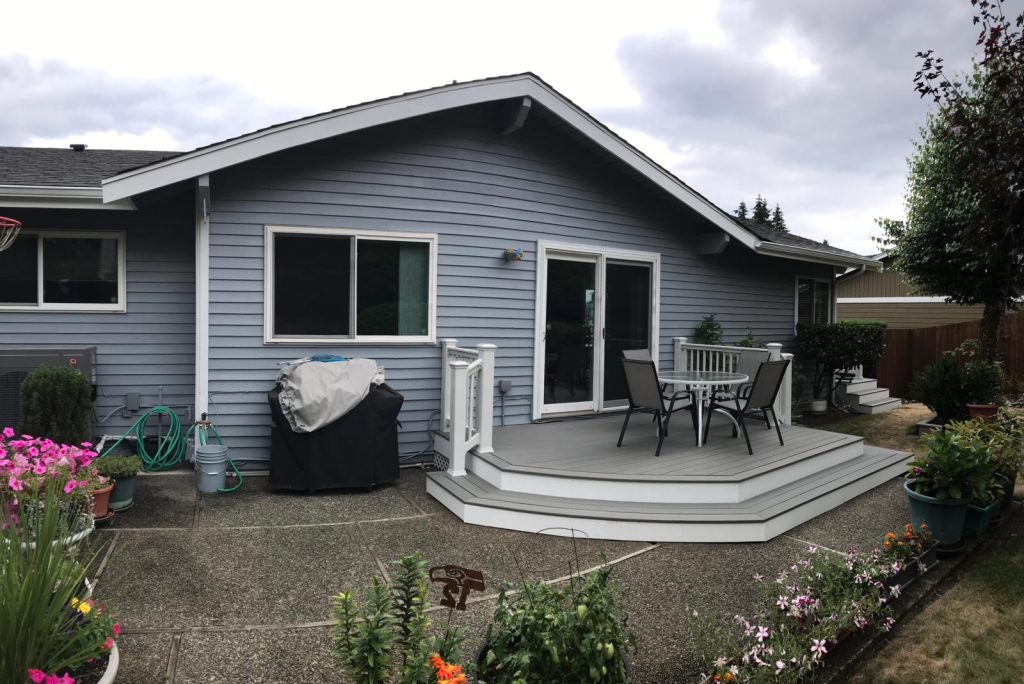
Not every old deck needs a full rebuild. Deck resurfacing can be cost-effective when the existing structure is still sound. The process removes old boards and railings, then exposes the framing for inspection, and Honeycomb checks the joists, ledger board, post bases, beams, footings, stair stringers, rot pockets, fastener corrosion, and drainage and ventilation before moving forward.

If the frame is structurally sound and the footprint doesn’t change, resurfacing can reduce cost and simplify the permitting path. If the frame is rotted or undersized, resurfacing becomes a risk, and new composite boards should never go over weak framing.

Why Honeycomb Fits Lynnwood, Edmonds, Mountlake Terrace, Mukilteo, and Mill Creek

Honeycomb Deck Builders works under Honeycomb Construction LLC, with Eugene and his brother directly involved in project execution, based out of 4901 NE 2nd St, Renton, WA 98059, with operations across Snohomish and King Counties.

Lynnwood homeowners typically compare three contractor types: high-volume installers, premium boutique builders, and design-build remodelers. Honeycomb sits in the design-build category, which means the deck team can coordinate with broader remodeling work when needed, including siding repair, painting, structural framing, kitchen and bath work, and flooring transitions. If old deck removal exposes siding rot, soft framing, or water damage at the house connection, Honeycomb has more construction capability to draw on than a deck-only crew.

Lynnwood Deck Services

Custom deck construction

built around the yard, grade, access points, load path, and material lifespan.

Covered decks

designed for year-round outdoor use, with attention to roof loads, water routing, post layout, and structural tie-ins.

Architectural pergolas

useful for shade, spatial definition, seating areas, and outdoor dining zones.

Structural deck resurfacing

a lower-cost path when the existing frame is sound and the homeowner wants new composite or PVC boards.

Capped composite decking

Trex and TimberTech-style boards for lower-maintenance outdoor living.

Cellular PVC decking

TimberTech AZEK-style boards for shaded, high-moisture yards where long-term moisture resistance matters.

Frequently Asked Questions

Decks under 200 square feet often don’t need one, but anything attached to the house, over 30 inches above grade, or over 200 square feet does. Confirm your property is actually within Lynnwood city limits before applying, since some Lynnwood-addressed properties sit outside the city boundary.
Cellular PVC has no organic wood fiber, which makes it hold up better in fully shaded, high-humidity yards where things dry slowly. Capped composite is a solid mid-range option too, but PVC is the stronger fit specifically for damp, shaded conditions.
Composite and PVC boards expand and contract with temperature. Tight butt joints on a long run can push boards into each other in hot weather, causing buckling, fastener shear, or visible waves in the surface. Correct expansion gaps prevent that.
If the frame, joists, ledger, posts, and footings are still sound, resurfacing with new composite or PVC boards can cost less and simplify permitting. If the frame is rotted or undersized, resurfacing over it is a risk rather than a shortcut.
Any deck surface more than 30 inches above ground needs a guardrail at least 36 inches high, with baluster spacing under 4 inches. Rail posts need proper blocking and hardware to hold that load.

Book a Lynnwood Deck Consultation

A Lynnwood deck should be designed around moisture, structure, permit triggers, material movement, guardrail safety, and long-term cost. Honeycomb Deck Builders can inspect the existing structure, compare cedar, capped composite, and cellular PVC options, review permit triggers, provide 3D layout planning, and prepare an itemized estimate before work begins.

Call (425) 273-4313 to schedule a Lynnwood deck consultation.
Scroll to Top