Engineered for the Bluff: Custom Deck Builders in Shoreline, WA
Honeycomb Deck Builders serves Shoreline and the greater Seattle area from its Renton operations through Honeycomb Construction LLC, building custom wood decks, capped-composite decks, covered decks, structural deck repairs, and pergolas for homeowners near Richmond Beach, The Highlands, Innis Arden, Echo Lake, Ridgecrest, and Meridian Park. Shoreline decks deal with more than rain: sandy loam, glacial till, wet coastal soils, steep grades, tree cover, winter wind, and long stretches of poor drying weather all shape how a deck needs to be framed.
This isn’t simple carpentry. Shoreline’s bluff conditions, damp soil, and coastal exposure call for soil review, footing selection, flashing discipline, and contractor compliance before the surface boards get picked.
Foundation Selection for Shoreline's Soils
A deck foundation should match the land. Shoreline has flat suburban lots, but it also has coastal bluff zones, saturated soils, slope movement, and erosion-prone pockets near the Puget Sound edge. Standard shallow footings work fine on stable ground. They become risky once the soil holds water, shifts under load, or sits on a grade that moves during wet seasons.
Helical steel piles get drilled into load-bearing soil using steel shafts with helical plates, transferring load deeper into the ground instead of relying on shallow surface soils. Honeycomb evaluates these for sloped coastal lots, bluff-adjacent properties, water-saturated soils, unstable fill areas, elevated or multi-level deck structures, and sites where excavation access is limited.
Pin piles or properly sized concrete footings work where soil conditions are stable. Honeycomb evaluates these for ground-level decks, standard suburban backyards, low-elevation deck replacements, and repair work with localized footing upgrades.
The goal isn’t to overbuild every project. It’s to match the foundation to soil, slope, load, access, and budget.
Avoiding Concrete Honeycombing in Footings
The Honeycomb name is friendly. Concrete honeycombing is not. In concrete work, honeycombing means voids or air pockets inside a footing, usually from poor placement, aggregate that’s too coarse for the rebar spacing, or vibration that’s cut short during the pour.
In Shoreline’s damp soils, those voids trap water. Trapped moisture expands in cold weather, and the concrete cracks, flakes, and loses section strength over time. Honeycomb prevents that through proper footing sizing, soil-aware foundation selection, correct concrete placement, controlled vibration during pours, aggregate selection suited to the footing and rebar layout, inspection before backfill, and correction of any voids before they become water traps.
A deck is only as stable as the foundation carrying it.
Moisture Protection: Cedar and Composite
Shoreline’s microclimate attacks exposed wood slowly. Fog, rain, shaded yards, marine air, and winter dampness push moisture into board ends, fastener holes, joist tops, stair stringers, and rail posts. The surface may dry while the cut end stays wet, and that’s where rot starts.
Western Red Cedar remains a good choice for homeowners who want natural grain, warm color, and a Pacific Northwest look, but every exposed cut needs protection. Cut ends absorb moisture faster than factory faces because the grain is open, and Honeycomb seals that end grain on stair stringers, railing components, fascia cuts, deck board ends, pergola posts, beam ends, and trim transitions to cut off the path for fungal growth and rot. Natural wood rewards maintenance and punishes shortcuts.
Capped composite boards offer a more moisture-resistant surface for homeowners who want lower upkeep. Composite decking doesn’t remove the need for proper framing, it changes the maintenance profile: the joists, beams, footings, ledger, flashing, fasteners, and drainage still decide the deck’s life. Honeycomb pairs composite boards with moisture-managed framing, correct board spacing, proper fastener systems, clean end details, stable joist layout, careful stair and railing attachment, and drainage planning around the home. A premium board over weak framing is still a weak deck.
Registration, Bonding, and Tax Compliance
Honeycomb Deck Builders operates through Honeycomb Construction LLC under active Washington State L&I general contractor registration HONEYC801P9, valid through November 13, 2026. That registration matters because Shoreline deck work can expose more than surface boards: rotten framing, damaged siding, roof tie-in issues, failed gutters, or structural transitions at doors and windows. Honeycomb’s general contractor structure keeps the project under one accountable scope when deck work connects with structural framing, siding repairs, roof connections, gutter integration, exterior painting, drywall or trim repair near access points, covered deck structures, pergola framing, or storm-damage stabilization.
RCW 18.27 governs Washington contractor registration and requires contractors to maintain registration, bonding, and liability coverage so homeowners aren’t left relying on informal promises. Under this framework, homeowners can verify a contractor’s registration status, legal business identity, bond status, insurance status, expiration date, and registration classification.
Planning a Shoreline Deck Project
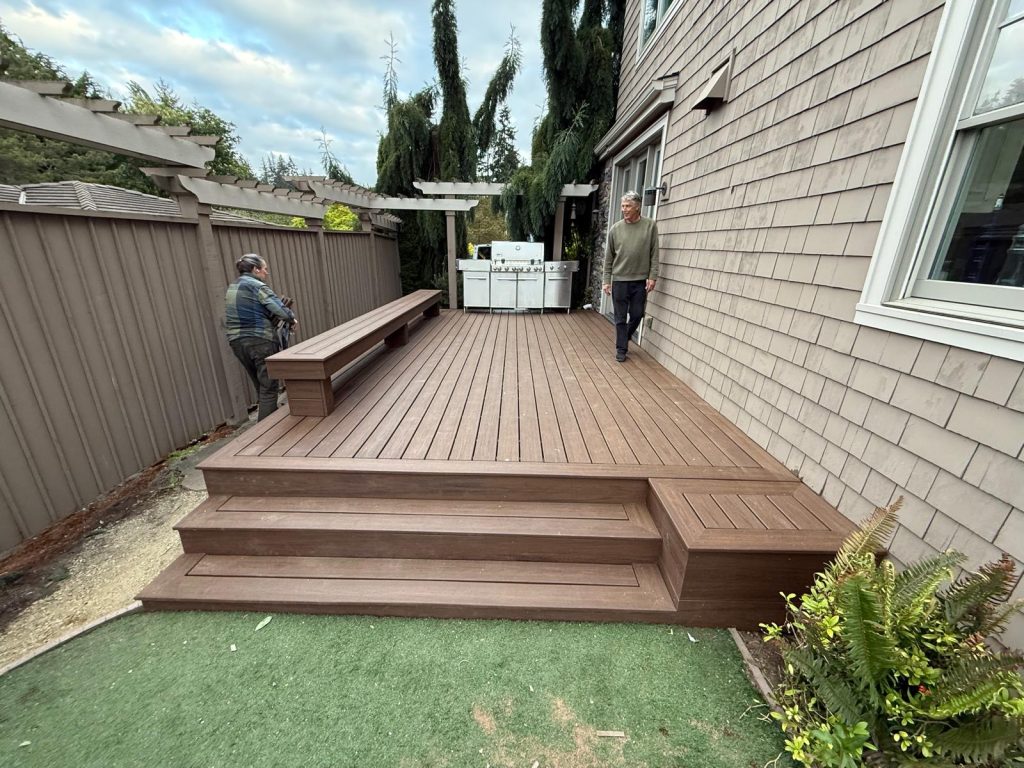
Shoreline deck pricing depends on elevation, soil conditions, access, material selection, railing choice, and framing complexity, and on whether the project is a repair, a replacement, or new construction. A flat cedar platform deck is a different build from a multi-level composite deck on a saturated slope, and a repair after a fallen tree is different from a full structural replacement. Honeycomb reviews the site first, then prices the structure, materials, access, and risk, so contact the team directly for a project-specific estimate.
Frequently Asked Questions
Does my Shoreline deck need helical piles, or will standard footings work?
It depends on the soil and slope. Helical steel piles make sense for sloped coastal lots, bluff-adjacent properties, and water-saturated or unstable soils, while pin piles or properly sized concrete footings are fine for stable, flat suburban lots. Honeycomb evaluates the site before recommending either.
What is concrete honeycombing, and why does it matter for a deck footing?
It’s voids or air pockets inside a footing, usually from poor concrete placement, aggregate that’s too coarse for the rebar spacing, or short vibration during the pour. In Shoreline’s damp soil those voids trap water, which expands in cold weather and cracks the concrete over time.
Should I choose Western Red Cedar or composite decking for a Shoreline property?
Cedar gives a natural grain and warm color but needs the cut ends sealed and regular maintenance to resist Shoreline’s fog and marine humidity. Composite trades a higher upfront cost for lower ongoing maintenance, though it still depends on solid framing underneath.
How do I confirm Honeycomb's Washington L&I registration is current?
Look up registration HONEYC801P9 directly on the Washington L&I contractor database, which shows active status, bond status, insurance status, and expiration date. Don’t rely on a directory listing’s phone number or license display alone.
What happens if I need emergency deck repair after a storm?
Honeycomb offers 24/7 storm repair dispatch with a standard $200 mobilization fee to secure the structure and assess whether it needs repair, temporary support, or full replacement.
Secure Your Shoreline Outdoor Space
Shoreline’s winter windstorms can turn weak deck framing into an emergency. Fallen limbs, saturated soil, loose rail posts, compromised stairs, and damaged gutters can make an outdoor structure unsafe fast. Honeycomb offers 24/7 storm repair dispatch with a standard $200 mobilization fee for emergency callouts, aiming to secure the structure, reduce further damage, and identify whether the deck needs repair, temporary support, or replacement planning.
For planned deck projects, Honeycomb provides direct communication with Eugeniu and his brother, practical material guidance, soil-aware foundation planning, and code-conscious construction under active L&I registration.
Request a Shoreline deck assessment from Honeycomb Deck Builders to review your soil conditions, framing, moisture risk, foundation options, material tier, emergency repair needs, and project estimate.